
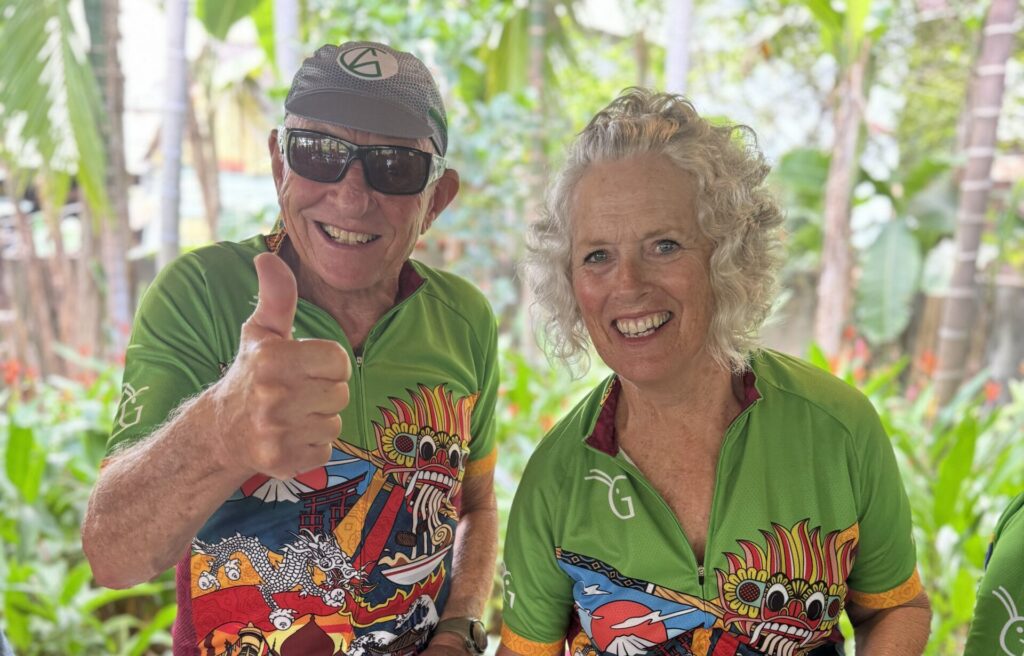
Riders considering a Vietnam cycling tour in their 60s often hesitate before booking, and the hesitation tends to cluster around a few predictable worries: not being fit enough, slowing down the rest of the group, the heat being unmanageable, medical risk feeling higher with age, or a general sense that this kind of trip is built for younger people. Each of these concerns deserves a direct answer rather than blanket reassurance, because some of them are simply wrong and others are entirely manageable with the right preparation.
On Fitness
Vietnam cycling tours are designed to be achievable by recreational cyclists, not racers. The relevant question isn’t “are you fast,” it’s “can you ride for 3-5 hours at a comfortable pace with regular breaks.” If you can comfortably ride 40-50 kilometers on a weekend at home, you’re already close; if you can’t quite do that yet, 8-12 weeks of consistent training generally closes the gap.
Riders who are retired sometimes have a real advantage here: more time to train consistently without squeezing rides around a work schedule, which often translates into more disciplined, better-paced preparation than younger riders manage on a tighter training calendar.
On Pace
Quality operators run a “no drop” policy, meaning the group rides at the pace of its slowest rider rather than leaving anyone behind — being that rider isn’t holding the group up, it’s setting the pace everyone else adjusts to. The support vehicle is also always available, so a rider struggling on a particular stretch can ride in air-conditioned comfort for a section and rejoin once recovered. Using the van isn’t a failure mode; it’s a reasonable way to manage energy across a multi-day tour, and riders who use it strategically often complete more of the trip, and enjoy more of it, than riders who insist on grinding through every kilometer regardless of how they feel.
On Heat
Vietnam’s heat is real, but it’s manageable with preparation and competent operations. Good operators start early to ride during cooler hours, schedule long breaks during peak heat, run frequent rest stops with shade and cold water, and watch closely for early signs of heat stress. On the rider’s side, training in heat beforehand if possible, staying aggressively hydrated, and using electrolytes all make a real difference — and older riders sometimes manage heat better than younger ones precisely because they’re more willing to slow down and take a break rather than push through.
On Medical Concerns
This is where operator quality really matters. A good operator reviews medical histories carefully before the tour, trains guides in advanced first aid, maps hospital locations along every route, and has clear evacuation protocols in place. Being honest on medical questionnaires, bringing necessary medications, and telling a guide about any condition that might affect riding all help staff provide appropriate support — the screening exists to help manage real conditions safely, not to exclude anyone.
On Whether This Is “For Young People”
It generally isn’t, in practice. Most Vietnam cycling tourists tend to skew toward an older, time-flexible demographic rather than the 20-somethings often featured in marketing photos, largely because younger professionals frequently don’t have two or three weeks of vacation available, while retirees often do. Riders in their 60s and beyond aren’t outliers on these tours — they’re a substantial part of who actually books them.

What Older Riders Often Bring to a Group
A few things tend to show up consistently in age-diverse groups: more patience and less hurry, a willingness to stop for a photo or a conversation rather than push through; broader life perspective that gives context to what’s being seen; a clearer sense of personal limits and less ego attached to using the support vehicle when needed; and often a level of gratitude for the experience that comes through in how the trip gets talked about at group dinners, which tends to enrich the social side of the trip for everyone, not just older riders themselves.
What Actually Helps With Preparation
Capacitación give yourself at least 12 weeks, build gradually, and prioritize time in the saddle over speed. Practicing consecutive riding days matters specifically, since the body needs to learn to recover while still moving rather than fully resting between efforts. If you’re not currently cycling regularly, a flatter route like the Mekong Delta is a reasonable starting point before attempting something more demanding.
Medical clearance: talk to your doctor before the trip, not for permission but for information — understanding how any existing condition or medication (some blood pressure medications affect heat tolerance, for instance) might interact with sustained heat and exertion is worth doing in advance rather than discovering it mid-tour.
Heat adaptation: if you live in a cooler climate, 2-3 weeks of deliberate heat training before departure (overdressing on an indoor trainer, riding at midday, even a sauna or hot bath routine) gives your body a real head start.
Operator selection: look for smaller group sizes, ask directly about the operator’s experience with older riders, confirm they have solid medical support and flexible rather than rigid daily pacing. E-bike options, where available, are also worth considering — they’re not a lesser way to do the trip, just a tool that lets some riders cover more distance and climb more comfortably than they otherwise could.
The Real Question
The riders who tend to struggle on these tours generally aren’t the older ones — they’re the unprepared ones, or the ones too proud to use the support vehicle when they need it, or the ones who don’t listen to their own body or their guide. None of those problems are specific to age. The riders who do well are the ones who trained seriously, arrived with realistic expectations, and were willing to accept help when it made sense — and those qualities, if anything, tend to come more naturally with age and experience rather than less.
So the answer to “am I too old for this” is: probably not, as long as you’re willing to prepare for it seriously and accept support when you need it. Age on its own isn’t really the deciding factor.
