
Lo que encontrarás en este artículo
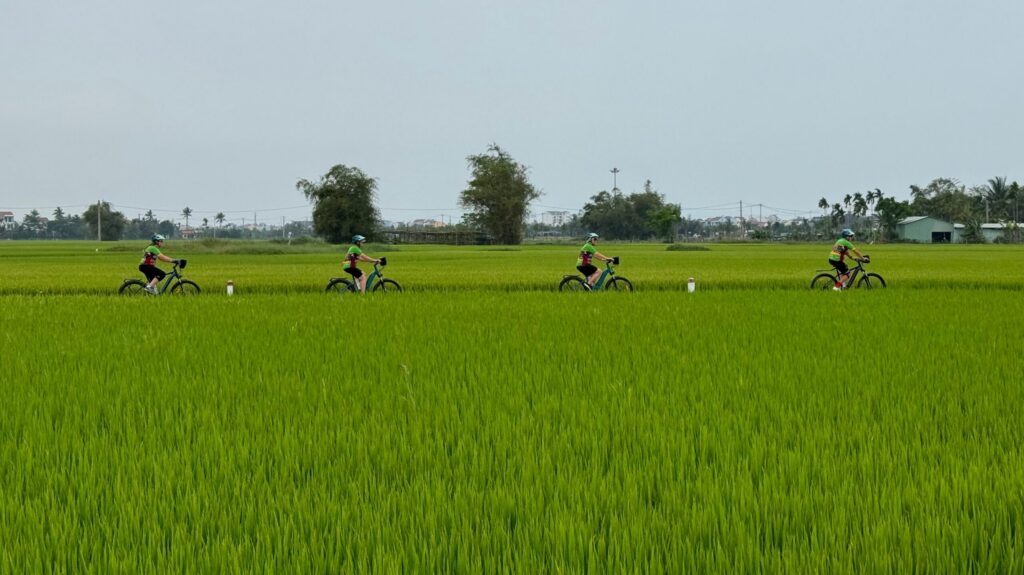
A 20-person cycling tour is considerably more profitable than a 10-person tour, not because revenue doubles and costs stay flat, but close to it: fixed costs (one lead guide, one support vehicle, one set of hotel bookings) barely move, while variable costs go up only marginally. So when an operator caps groups at 10-12 instead of running 20-24, they’re leaving real money on the table, deliberately, tour after tour. The reasons come down to pace, safety, and how much individual attention is actually possible at different scales.
The Pace Problem
In a group of 8, the gap between the fastest and slowest rider on a given climb might be 400 meters — manageable for a lead guide to track, and small enough that rest stops naturally bring everyone back together. In a group of 20, that gap can stretch to 2-3 kilometers, effectively splitting the tour into a fast pack up front, a struggling middle, and a tail that increasingly feels like it’s holding everyone up.
The social dynamics shift accordingly. In small groups, people generally know each other by day two, and conversations and connections form across the whole group rather than within speed-based cliques. Reviews that mention a group “feeling like family” tend to come from tours under 12 riders; reviews describing a tour as “fine but impersonal” tend to come from larger ones. This isn’t really a coincidence — there’s a practical limit to how many relationships a group can build in a week or two, regardless of how good the guide is.
The Safety Math
Quality operators generally staff at one guide for every 6-8 riders, which means a group of 10 gets both a lead guide up front and a dedicated sweep guide at the back, so someone is always watching the tail of the group. Operators running groups of 20+ often staff the same way they would for 10 — one lead guide, one support vehicle, maybe a second guide — which means the staff-to-rider ratio drops to somewhere between 1:7 and 1:11.
The practical effect: in a smaller group with a dedicated sweep, the maximum time anyone is genuinely alone after a mechanical or a fall is roughly however long it takes the sweep guide to reach them, usually under two minutes. In a larger group without that dedicated coverage, a rider who drops off the back during a quiet stretch can go unnoticed for considerably longer. That gap matters more for a real medical issue than it does for a flat tire.
The Bottleneck Effect
Vietnam’s infrastructure handles small groups easily and chokes on large ones. A roadside café with ten chairs seats ten cyclists without friction; with twenty-two, half the group is standing while the other half eats. A rural bathroom stop that takes ten minutes for a group of eight can mean a thirty-minute queue for a group of twenty. A scenic overlook on Hai Van Pass lets eight people get their photo in five minutes; twenty people either rush through or spend half an hour there. Crossing a busy intersection safely with eight riders is manageable; doing the same with twenty-two means either splitting the group or stopping traffic for an extended period. And a homestay dinner that’s a genuine cultural exchange for eight guests becomes something closer to a tour bus arriving at someone’s home once the numbers climb much higher.
The Personalization Gap
Before a tour starts, staff at a quality operator have already reviewed each rider’s medical history, dietary restrictions, and fitness level. With 8-10 clients, a guide can reasonably hold all of that in their head and adjust in real time. With 20+, that becomes cognitively unrealistic for any guide, however good, and the experience necessarily standardizes — not from lack of care, but because individualized attention at that scale isn’t really possible for one or two people to deliver.
What Tends to Get Cut at Lower-Cost, Higher-Volume Operators
To make large-group economics work, operators commonly cut in a few specific places: staffing ratios drop, as described above; guide quality drops, since paying guides well enough to make it a career is harder to justify against thinner per-rider margins, leading some operators toward seasonal or less experienced staff; equipment ages faster, since larger fleets at lower margins get replaced less often; route reconnaissance happens less frequently, since the same route sheet might get reused for years without a fresh check on current conditions; and medical preparedness tends to be more basic, with less comprehensive kits and less frequent staff training.
None of this means every large-group tour is poorly run, or that every small-group tour is automatically excellent. But the economics described above are real, and they tend to produce a fairly consistent set of trade-offs.
What to Ask When Comparing Operators
A few direct questions tend to be revealing: what’s the maximum group size (above 14 is worth a closer look, and a vague “depends on the tour” without specifics is a mild yellow flag); how many guides will actually be on your specific tour, since the ratio matters more than the headcount alone; is there a dedicated sweep rider, and if not, what happens if someone has a mechanical at the back of the group; and what’s the typical group size on recent departures, since operators sometimes advertise a generous maximum while routinely running smaller groups in practice.
Group size isn’t just a logistics detail. It’s a reasonably direct signal of whether an operator is optimizing for the per-rider experience or for filling as many seats as the route can technically support.
For more on evaluating Vietnam cycling operators, see “How to Choose a Vietnam Cycling Tour Operator: The Complete Evaluation Guide.”
