
What You'll Find in This Article
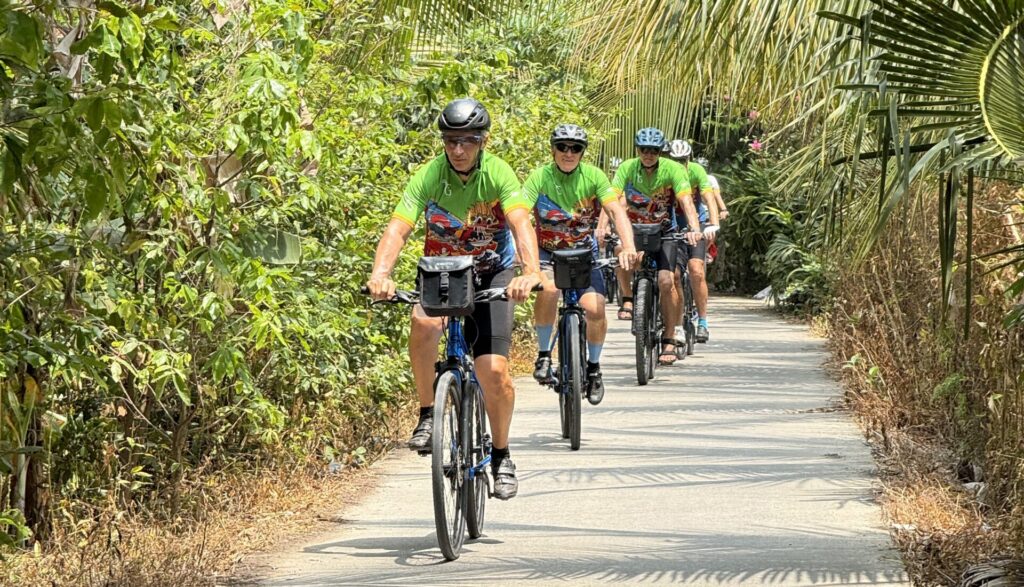
Every group cycling tour runs into the same basic tension: riders show up with different fitness levels, but everyone paid for the same trip and wants a good experience out of it.
The faster riders don’t want to spend the tour bored at rest stops. The slower riders don’t want to feel like they’re the reason everyone else is waiting. And a guide who handles this badly can turn a good route into a tour that feels fractured by day three.
There are two common but flawed approaches to this problem.
Letting the group split. Faster riders go ahead, slower riders fall behind, and everyone effectively rides their own tour. This is easy on the guide but costly to group cohesion — by the end of a multi-day trip, you often end up with two or three loosely connected subgroups who barely interact, which undercuts a big part of why people book group tours in the first place.
Forcing everyone to stay together. Holding faster riders back and pushing slower riders harder tends to create resentment on both ends: faster riders feel like they’re paying to be slowed down, and slower riders feel responsible for holding up the group.
Better guides take a third approach: adjusting pace and structure quietly enough that the group experiences cohesion without anyone feeling managed.
How It Actually Works
None of this requires announcing a strategy or holding a meeting about pace. It comes down to a handful of small, consistent adjustments.
Strategic rest stop placement. Rest stops are placed immediately after the hardest sections of a route, not before. Stopping before a climb means fast riders attack it fresh while slower riders struggle through it alone; stopping after means the climb itself acts as the equalizer, since the climb takes longer for slower riders, which gives faster riders time to recover and lets the whole group regroup naturally on the other side.
Gradual pace adjustment. When a guide notices the group stretching out, they’ll often ease the lead pace down by a couple of kilometers per hour without announcing it. The lead riders rarely notice, since they’re usually chatting or taking in the scenery, while the riders further back close the gap without having to work harder to do it.
Using scenic stops to compress the group. The photo stops at viewpoints aren’t placed at random. By the time the lead riders have arrived and taken their photos, the back of the group has usually caught up, and the regroup happens without it ever being framed as “waiting for the slower riders.”
Giving faster riders something to do. Riders who are clearly stronger than the group average tend to do better with a task — riding ahead to confirm a turn, scouting the lunch stop, or checking on a rider further back — rather than just being told to wait. These are genuinely useful jobs, not busywork, and they turn extra speed into something the group benefits from instead of something that creates distance.
Riding alongside someone who’s struggling. A guide positioned just ahead and slightly to the side of a tired rider creates a partial draft that meaningfully reduces effort, and steady conversation alongside it helps take attention off the discomfort. The rider experiences the climb as easier without necessarily registering why.
Frequent short regroups. Calling a quick headcount stop every 10-15 kilometers, even for just a couple of minutes, prevents the kind of large gaps that are much harder to close once they’ve formed. It’s a lot easier to keep a group together continuously than to bring a badly fragmented group back together later.
The Support Van Isn’t a Consolation Prize
One thing worth establishing early on any tour: using the support van for a section isn’t giving up. Plenty of riders show up believing that riding every single kilometer is the only legitimate way to finish a tour, and that belief causes more problems than it solves — riders pushing through pain or heat stress they shouldn’t, purely to avoid the idea of “giving up.”
A more useful framing is that managing your effort across a multi-day tour, including using the van on a hard day, is what lets you ride well on the days that matter most to you. A rider who takes the van for a stretch in unexpectedly bad heat on day three, rather than forcing the issue, often has a stronger day seven than someone who insisted on riding through everything regardless of how they felt.
Treating support as a normal part of managing a multi-day effort, rather than as a failure mode, is itself part of good pace management. It gives a struggling rider a way to step back without it costing them socially or making them feel like they slowed the group down, and it often means they rejoin later in better shape than if they’d pushed through.
What This Looks Like as a Rider
On a well-run tour, you’ll generally find the group arriving at rest stops within a few minutes of each other, despite real differences in fitness, because the route and pacing are doing quiet work to compress that gap. You won’t feel rushed or held back for long stretches. You’ll tend to eat lunch with the people you were actually riding with that morning, rather than people you haven’t seen since breakfast.
Most of this isn’t something you’re meant to notice directly. It just registers as a tour that felt well-run, with a group that got along.
Why It’s Hard to Evaluate From the Outside
Bike quality, guide certifications, and group size are all things you can check before booking. Pace management is harder to assess, since there’s no certification for it and it rarely shows up in marketing copy.
A few reasonable proxies: reviews that specifically mention group cohesion rather than just individual experience, reviews from riders across a visible range of fitness levels who all describe a good trip, operators who keep the same guides for multiple years (since this is a skill that develops with repetition, not something picked up in a week), and smaller group sizes that make individualized attention more realistic to begin with.
