
What You'll Find in This Article
For most of a Vietnam cycling tour, the support van is a background presence. It’s somewhere behind the group, hazard lights on, carrying luggage and occasionally showing up at rest stops with cold water.
Most riders don’t think much about it. But the van is, in practical terms, one of the most important pieces of equipment on the tour. It’s a mobile repair shop, an air-conditioned place to recover, a first-response medical station, and a backup way to move people and bikes when something goes wrong.
Here’s what a well-stocked support van actually carries, based on the standard kit used on our tours.
The Bike Shop on Wheels
Spare bikes. At least two complete spare bikes, sized to cover the range of riders on a given tour. If a bike fails catastrophically — a cracked frame, a destroyed wheel, anything that can’t be fixed roadside — a rider can be back on a bike in a few minutes. The spares are the same quality as the bikes the group rides, not downgraded backups.
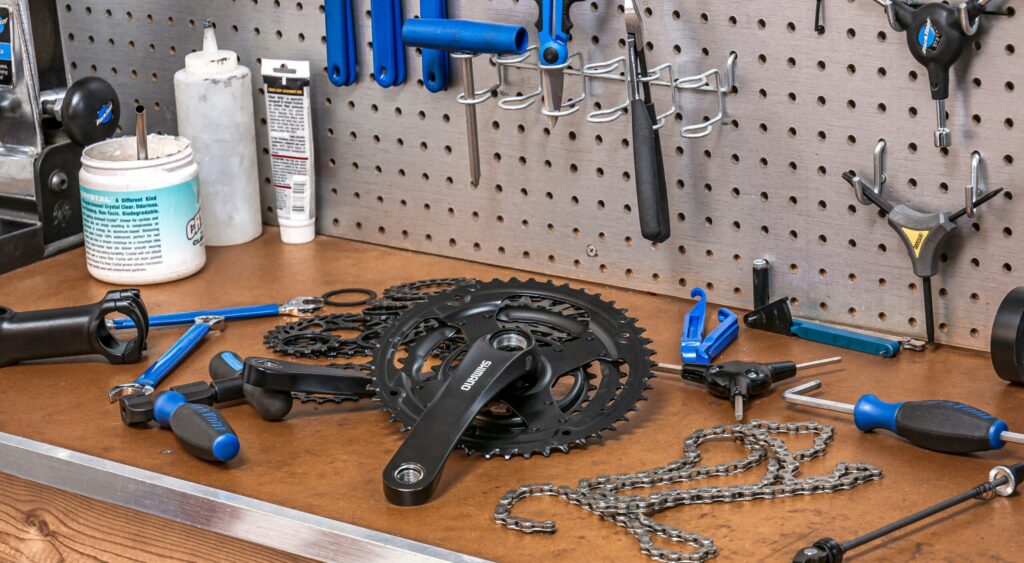
Repair equipment. A complete multi-tool set, multiple tire levers, a portable floor pump with a pressure gauge, two spare tubes per wheel size in use, a patch kit, spare folding tires, a chain tool with master links, spare chains, brake pads for both rim and disc brakes, brake and shift cables and housing, derailleur hangers for each bike model in the fleet, spare pedals and cleats, a spoke wrench and spare spokes, quick links, cable cutters, chain lube, cleaning rags, zip ties, electrical tape, and hand cleaner.
With this kit, a sweep guide or driver can resolve nearly any mechanical issue without the van leaving sight of the group. Frame failures are really the only problem that requires falling back on a spare bike rather than a repair.
Bike transport capacity. The van can carry at least four bikes internally, more with racks. This matters when riders and their bikes both need transport, or when weather forces the whole group into vehicles.
The Medical Station
A proper support van carries a first aid kit well beyond band-aids, since the nearest hospital can be an hour or more away and language barriers complicate things further.
Wound care: sterile gauze pads in multiple sizes, adhesive bandages, butterfly closures, non-stick dressings for road rash, cloth and waterproof medical tape, elastic bandages, triangular bandages, rolled gauze, antiseptic wipes, antibiotic ointment, and saline or hydrogen peroxide for cleaning wounds. Road rash is the most common cycling injury, and a properly stocked kit can clean and dress a significant abrasion well enough to either continue the tour or get a rider comfortably to professional care.
Medications: both ibuprofen and acetaminophen, since not everyone can take either one; anti-diarrheal medication, since travel stomach issues are common and genuinely debilitating on a bike; antihistamines; antacids; oral rehydration salts, critical for heat exhaustion and dehydration; anti-nausea medication; and hydrocortisone cream. If any client has disclosed a severe allergy, the van also carries an epinephrine auto-injector, and guides are trained to use it.
Assessment equipment: a digital thermometer, since body temperature is the key indicator distinguishing heat exhaustion from heat stroke; a pulse oximeter for assessing breathing issues and heat stress; and a blood pressure cuff for guides trained to use one.
Trauma equipment: a SAM splint for suspected fractures, a CPR face shield, instant cold packs, an emergency blanket (useful for shock as much as cold), an eye wash kit, a tick removal tool, disposable gloves, and trauma shears that can cut through cycling kit. On tours running through more remote areas, a cervical collar is included as well, used only by guides trained in spinal immobilization.
Hydration and Nutrition
In Vietnamese heat, hydration isn’t a convenience, it’s a safety system. The van carries a large cooler restocked with ice daily, cold water (2-3 bottles per rider per stop, more in extreme heat), electrolyte sports drinks, oral rehydration solution for early dehydration signs, energy bars and snacks, fresh fruit bought each morning, and glucose tablets for quick energy or diabetic emergencies. Wet towels kept in the cooler are a simple but effective cooling tool for an overheating rider.
A Mobile Recovery Space
The van is air-conditioned, which matters more than it sounds. Moving a rider from 35°C ambient heat into a 22°C vehicle is immediate, meaningful cooling, and the van effectively becomes a place to rest and lower core temperature before deciding whether to continue.
Some budget operators run non-air-conditioned vehicles. In Vietnam’s heat, that’s a safety gap, not just a comfort one. The van also carries a shade tent or awning for stops without natural shade, and folding chairs.
Communication and Navigation
The driver also functions as a communications and navigation backup: a two-way radio for contact with lead and sweep guides, at least two mobile phones on different networks with local SIM cards, chargers and a backup battery pack, a GPS unit, and physical maps as a fallback if electronics fail. On more remote routes, a satellite phone or emergency beacon covers the gaps in mobile coverage.
The van also carries the day’s route card — a laminated sheet with hospital locations, emergency numbers, alternative routes, and hazard notes — so the driver can take over navigation or emergency response if needed.
Safety Equipment
A fire extinguisher, warning triangles, high-visibility vests for all passengers, flashlights with extra batteries, and reflective tape round out the safety gear. The van itself is marked with signage in Vietnamese and English identifying it as a cycling tour support vehicle, partly for visibility and partly because drivers who recognize it as following a cycling group tend to give more space.
Everything Else
Sunscreen and insect repellent (riders run out or forget to reapply), toilet paper, hand sanitizer, wet wipes, a small sewing kit and safety pins for jersey repairs, hair ties and headbands, cash in Vietnamese dong for unexpected expenses, client medical information sheets and emergency contact cards, and a small cooler bag for medications like insulin that need to stay cold.
Why the Inventory Looks Like This
Most of what’s in the van goes unused on any given tour. The epinephrine might be needed once every couple of years. The satellite phone might never be used at all. But the standard for what gets carried isn’t “how often does this come up” — it’s “what happens if it’s needed and we don’t have it.” That’s not a comfortable position to be in if someone is hurt on the road.
The inventory is, in a real sense, a list of everything the operator has thought through in advance: mechanical failure, dehydration, a crash, an allergic reaction, getting lost, getting sick.
Most days, the van is just the vehicle carrying bags and showing up with cold water. The rest of the time, it’s the reason a bad day on tour stays a bad day instead of something worse.
This article is part of a series on Vietnam cycling operations. For more on safety systems, preparation, and what separates quality operators from budget alternatives, see the complete Vietnam Cycling resource collection.
