When cyclists tell their friends they’re spending two weeks cycling through Vietnam, the response is usually: “Why Vietnam? Why not Italy? Or New Zealand?”
Standing at the summit of Hai Van Pass, with mountains plunging into the South China Sea, answers that question. Vietnam isn’t competing with Tuscany’s hills or the Southern Alps. It’s doing something different.
What Most Cyclists Get Wrong When Planning a Dream Tour
Most people planning a cycling trip chase scenery: the Alps, Patagonia, the Scottish Highlands. All worthy choices. But a 1,700-kilometer corridor in Vietnam offers something most of those destinations can’t: a complete experience that most tourists only see from a bus window.
Vietnam doesn’t have the highest mountains, the longest coastal roads, or the most developed cycling infrastructure. What it has is range, packed into two weeks.
Maximum Diversity, Minimum Distance
The Alps: spectacular, but thematically consistent. You’re riding variations of the same alpine scenery and European villages for the whole trip.
Patagonia: jaw-dropping wilderness, but days of similar landscape. Steppe, mountains, more steppe, more mountains.
New Zealand: stunning and varied, but you need months to get the range. North Island to South Island, coast to mountains.
Vietnam, in the same two weeks, takes you through:
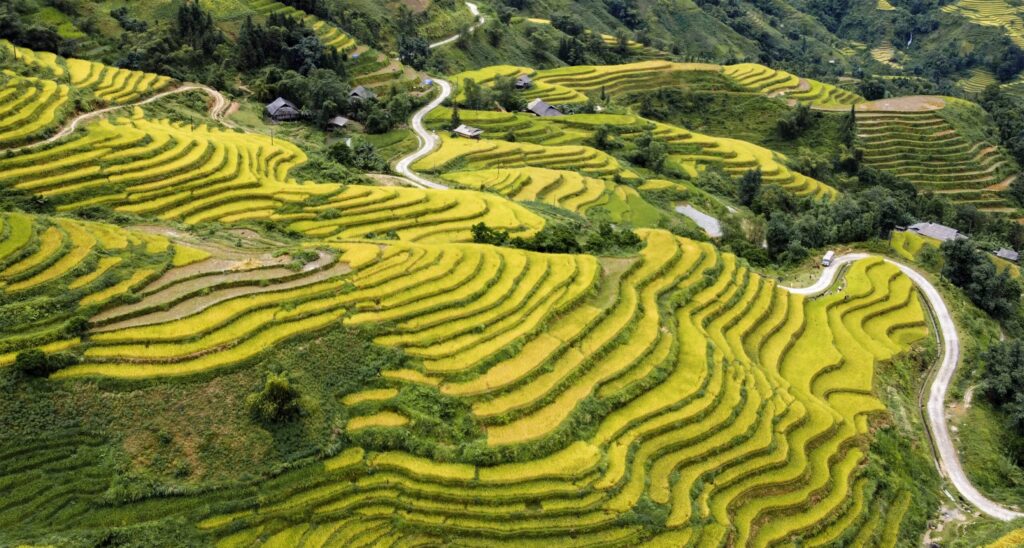
- Misty highlands where H’mong women in indigo-dyed clothing work terraced rice fields that have existed for 2,000 years
- Tropical coastline where turquoise water meets white sand
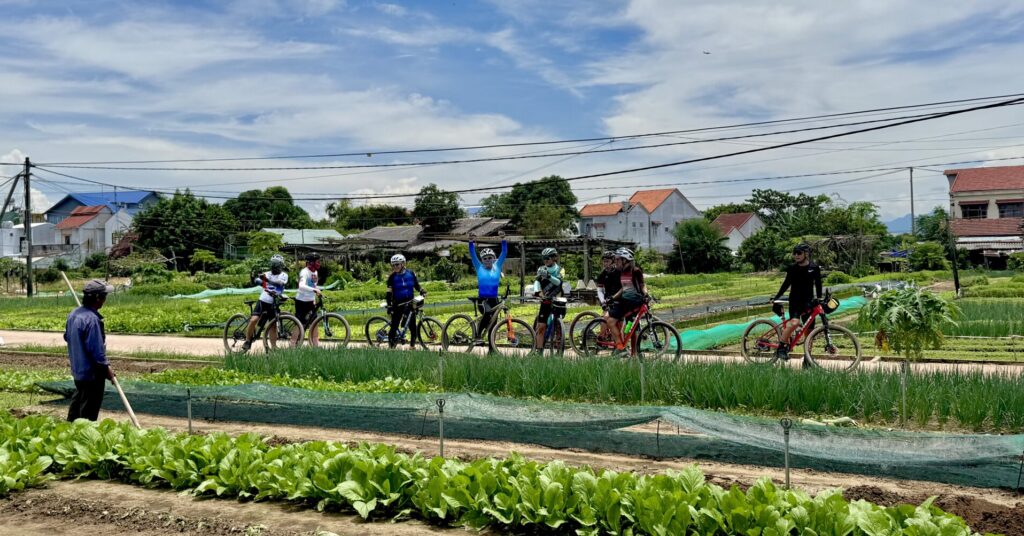
- River deltas where life happens on water: floating markets, fishing villages, boats that double as homes and shops
- Jungle-clad mountains carrying remnants of the Ho Chi Minh Trail
- Ancient trading towns where Japanese, Chinese, and European architecture blend in UNESCO-protected condition
- Modern cities where motorbikes outnumber cars by a wide margin
This isn’t a curated highlight reel. It’s the natural progression of riding from Hanoi to Ho Chi Minh City: mountains to coast, past to present, rural to urban, in 1,700 kilometers over two weeks.
“Challenging But Safe” Isn’t a Compromise
Most cycling destinations force a choice. Go hard (Peru’s Andes, Nepal’s Himalayan passes, Patagonia’s wind-blasted steppes) and accept real risk: altitude sickness, remoteness, months-long commitments. Or go safe (European tours, Napa Valley) and give up the sense of adventure.
Vietnam manages both, and the reason isn’t luck. It’s preparation.
What Happens Behind the Scenes
A rider mid-climb on a Vietnamese mountain pass starts showing signs of heat exhaustion: elevated heart rate, flushed face, tingling hands. A trained guide recognizes this and stops the rider, even though the rider wants to keep going. The rider finishes the climb in an air-conditioned support van, cools down, rehydrates, and two days later often rides an even longer climb successfully.
Most operators either let riders push through (risky) or avoid challenging terrain altogether (boring). The better operators build systems, standard procedures developed over years, that let riders push themselves while someone else manages the risk.
What this looks like in practice:
60 days before the tour: – Medical history reviewed, response plans created for likely issues – Every bike gets a two-hour inspection – Guides drive the full route, photographing hazards, timing climbs, mapping hospital locations – Staff train on emergency scenarios: heat stroke, crashes, mechanical failures
Every morning: – 6 AM staff meeting on weather, route conditions, and any concerns from the previous day – Bikes re-inspected and adjusted – Support vehicles loaded with spare bikes, first aid kits, tools, ice water, snacks
During the ride: – Guides communicate by radio every 30 minutes – Support vehicles hold a 100-200 meter following distance with hazards on – Rest stops every 20-30km, more often in heat, regardless of whether anyone asks – Traffic protocols at every major intersection
Riders rarely see any of this. A guide carries a laminated card with hospital locations and alternate routes for every day of the tour. The “random” lunch stop was scouted two weeks earlier, with dietary restrictions communicated in advance, in Vietnamese. The bikes were built for Vietnamese conditions after years of adjustment.
The roads are rough and the heat is real, but the operational layer behind a good tour is genuinely well-built. You get the challenge. The guides handle the risk.
The Altitude Advantage
Many bucket-list cycling destinations make you miserable for the first week. The Andes will give you headaches, nausea, insomnia, and lethargy while your body adjusts to altitude over 3,000-4,000 meters. The Himalayas are worse, with the added problem that medical evacuation can take days. Even parts of the Alps, with passes over 2,000 meters, are enough to bother sensitive riders.
The highest point on the classic Hanoi-to-Saigon route is about 1,500 meters. Most riding happens between sea level and 500 meters. Hai Van Pass and the Central Highlands climbs feel dramatic but don’t require any acclimatization.
You land in Hanoi, sleep in a normal bed, and start riding the next morning.
A first-time cyclist tackling the Andes might spend three or four days in Cusco feeling lousy, wondering if the trip was a mistake. Some people never adjust and spend the whole trip at a fraction of their normal capability. In Vietnam, a rider spends day one in Hanoi’s traffic, day two climbing through rice terraces, and by day five is summiting mountain passes with no altitude penalty at all.
That matters most for anyone over 50, anyone managing cardiovascular concerns, or anyone with limited vacation time who can’t spare a week to acclimatize before the trip actually starts.
Cultural Immersion, Done Differently
Most cycling destinations fall into one of two categories. Pastoral Europe gives you beautiful landscapes and charming villages that have catered to tourists for fifty years, where every interaction feels transactional. Remote wilderness, like Patagonia or the Highlands, gives you isolation and nature but little real cultural contact.
Vietnam offers something else: immersion that’s accessible without being staged.
What a Day Like This Looks Like
Day 8 of a typical tour. You wake at 5:30 AM and board a small boat on the Mekong Delta as mist rises off the river. You arrive at the Cai Rang floating market, where hundreds of boats trade vegetables, fruit, and noodles. Your guide’s grandmother, Mrs. Hoa, shows you how to sort produce, and you eat crab noodle soup for breakfast on a floating kitchen.
Later, a farmer invites you to try planting rice. You spend 30 minutes bent over in mud, your back aching, while the farmer does this for eight hours a day during planting season.
That evening, a homestay puts you in a stilt house by the river. Your hosts teach you to roll spring rolls, everyone eats family-style, and after dinner the kids teach card games while grandmothers bring out guitars and sing.
One traveler put it this way: “I’ve seen famous landmarks around the world. But sitting in a Vietnamese home, listening to songs I don’t understand but somehow feel, that’s why I travel.”
Why This Works Here
Three things make Vietnam well-suited to this kind of immersion. Tourism only fully opened up in the 1990s, so rural communities haven’t been worn down by decades of tour buses; your interest in their life is still genuinely novel. Many Vietnamese, especially younger generations, are notably welcoming to Western visitors despite a complicated shared history, often eager to show how far the country has come. And Vietnam is developed enough to make these experiences logistically possible, unlike rural Myanmar or Laos, without being so developed that they’ve turned into staged “cultural village” tourism, as has happened in parts of Thailand.
The Cost Reality
A 10-day cycling safari through Kenya and Tanzania sounds incredible, and it can be, but the bill adds up fast: $1,200-1,500 in flights, $3,500-5,000 for a mandatory guided tour, and $330-530 in visas and vaccinations. Total: $5,000-7,000 or more.
Cycling Peru, Ecuador, or Patagonia has its own math. Flights run $600-900, but you either need months (Patagonia alone takes 2.5 months to see properly) or expensive internal flights to connect regions, plus $50-100 and 2-3 weeks for apostilled background checks at land borders. Three weeks of a partial experience runs $2,500-4,000.
A 14-day Hanoi-to-Saigon tour looks different: $500-900 in flights depending on departure city, a $25 e-visa (or visa-free entry for travelers from the UK, Germany, France, Spain, or Italy), $1,200-1,800 for a tour with bikes, guide, support vehicle, most meals, and hotels, and $15-25 a day in spending money. Total: roughly $2,200-3,500.
For less than half the cost of an East Africa trip, you get the complete Vietnam experience, achievable in two weeks, with professional support and zero altitude issues, and you can book it for this year rather than planning years out.
This isn’t about Vietnam being cheap. It’s about a lower cost of living translating into more value per dollar, not a discount on quality.

Who Vietnam Is Actually For
The common assumption is that Vietnam cycling is for hardcore cyclists. It isn’t. You don’t need to be a racer, a century-ride veteran, or someone who owns thousands of dollars in carbon fiber. You need to be willing to push yourself within reason, open to some discomfort, curious about a culture beyond your own, and comfortable accepting support when you need it.
Riders who get the most out of Vietnam tend to share a few traits rather than a fitness level:
- They’re somewhere between 35 and 65 and decided their life needed more adventure than their desk allowed
- They exercise semi-regularly but aren’t training for the Tour de France, and want a real challenge without recklessness
- They’re tired of sightseeing and want to actually do something with their body
- They want culture that’s lived, not performed for tourists
- They have two or three weeks, not two or three months
- They want to come home different, not just with photos
Six Routes, One Country
Most countries have one signature cycling route. Vietnam has six, all reachable on the same visa and currency, with the same support infrastructure.
- The Classic: Hanoi to Ho Chi Minh City (14-21 days). The full experience: mountains, coast, culture, cities. A real narrative arc from the historical north through mountains and rice terraces, over the Central Highlands, down to tropical beaches, finishing in the southern metropolis. Difficulty: moderate to challenging. Best for first-timers with two to three weeks who want the whole journey.
- The Greatest Hits: Hue to Hoi An (3-7 days). The best one-week option. Includes Hai Van Pass, Hue’s imperial Citadel, Lang Co Bay’s beaches, and Hoi An’s ancient town. Difficulty: moderate. Best for first-time visitors with a week to spend.
- The Challenge: Ha Giang Loop (3-5 days). The most dramatic landscapes in the country, through Hmong and Dao villages on roads that test your nerve, including the Mã Pí Lèng Pass. Difficulty: challenging. Best for experienced cyclists wanting the road less traveled.
- The Cultural Deep Dive: Mekong Delta (3-5 days). Flat, slow, and deeply cultural rather than physically demanding. Floating markets, homestays, rice farming, river life. Difficulty: easy. Best for beginners, families, and culture-focused travelers.
- The Northern Mini-Loop: Hanoi-Mai Chau-Ninh Binh Circuit (3-5 days). A short introduction covering the Mai Chau valley, rural homestays, and Ninh Binh’s karst landscapes. Circular, no backtracking. Difficulty: easy to moderate. Good for a long weekend or as an extension of a Hanoi business trip.
- The Cross-Border Epic: Hanoi to Luang Prabang or Saigon to Siem Reap (7-14 days). Extends into Laos or Cambodia, combining Vietnam’s infrastructure with northern Laos’s scenery or Angkor Wat’s history. Difficulty: moderate to challenging. Best for adventure cyclists with two or more weeks.
Each of these routes would be a country’s signature cycling experience on its own. The Mekong Delta route alone could carry Thailand’s tourism marketing. Hai Van Pass would be a national icon in New Zealand. In Vietnam, they’re simply options within one trip.
Getting There and Getting Around
From the US West Coast, Vietnam Airlines flies direct from San Francisco to Saigon in about 15 hours 40 minutes, for $500-800 roundtrip, shorter than most Europe trips. From the East Coast, expect one stop through Tokyo, Seoul, or Taipei, 20-24 hours total, for $700-1,100. From Europe, direct flights from Paris, London, or Frankfurt take 11-13 hours for €500-800. From Australia, it’s 7-9 hours from east coast cities, closer than Europe.
Visas are simple. Travelers from the UK, Germany, France, Spain, or Italy get 45 days visa-free. Everyone else pays $25 for an e-visa processed online in 3-5 days. Compare that to East Africa’s $80-150 in visa costs plus a mandatory yellow fever vaccination, or the multi-week apostille process for South American land borders.
Domestic flights between Hanoi and Saigon run $35-85, with around 25 flights a day, so skipping a section due to injury or time constraints is easy and cheap. English is widely understood in tourist areas, and Vietnam’s roads, mechanics, and hotels are all set up to handle two-wheeled traffic at scale.
What You’re Actually Buying
A Vietnam cycling tour isn’t really a way to see scenery, get a workout, or have a relaxing vacation. You can get those things more cheaply elsewhere. What you’re buying is evidence about your own capability.
A 61-year-old who “sometimes rode to work” climbs Vietnamese mountains and plants rice with farmers. A marathon runner who thought they’d seen everything forms relationships across a language barrier that change how they see people. A nervous first-timer ends up leading the group by the end of the trip.
It’s easy to believe limiting stories in ordinary life: that you’re too old, not fit enough, too busy, or that real change takes years. Riders in their 60s and 70s complete these tours. First-time distance riders discover strength they didn’t know they had. The trip fits a normal two-week vacation window. Vietnam doesn’t argue with those stories. It just contradicts them with two weeks of evidence.
The Challenges
Vietnam isn’t without real difficulty, and it’s worth being direct about what you’re signing up for.
The heat. Daytime temperatures of 30-35°C (86-95°F) are normal during riding season, and humidity makes it feel worse. Good tours start early, rest during peak heat, and keep ice water flowing every 20km. It’s manageable, but it’s not a European spring.
The traffic. Thousands of motorbikes and aggressive driving by Western standards look chaotic. It is, in a sense, but it follows patterns, and experienced guides know how to navigate intersections and route around the worst of it.
The roads. Expect smooth tarmac mixed with rough patches and potholes. Good operators scout routes in advance, warn riders, and provide appropriate tires.
The unfamiliarity. Street food, squat toilets in rural areas, language gaps, different norms. This is part of what makes the trip feel different from a standard vacation, not an obstacle to work around.
Vietnam asks more flexibility and tolerance for discomfort than a European tour. That’s also largely why people come back from it changed.
How to Choose the Right Trip
Step 1: Assess your time. One week: Hue to Hoi An. Two weeks: Northern Highlights plus the Central Coast, or a partial north-south route from Hanoi to Da Nang. Three or more weeks: the full Hanoi-to-Saigon route. One week and looking for a serious challenge: Ha Giang Loop. One week and new to touring: Mekong Delta.
Step 2: Assess your experience. New to cycle touring: start with the Mekong Delta or Northern Loop before attempting the full north-south. Experienced but new to Vietnam: Hue to Hoi An or the full route. Seeking a real challenge: Ha Giang Loop or one of the cross-border options.
Step 3: Choose a tour style. – Fully supported group tour ($90-150/day): 8-16 people, guide, sweep guide, support vehicle, hotels and most meals included. Good for first-timers and people who want company and ease. – Small group or private tour ($150-250/day): 2-6 people, flexible pace, higher-end hotels. Good for couples, families, and people who want a customized trip. – Self-guided with support ($50-80/day): you ride at your own pace with GPS routes, booked hotels, transported luggage, and emergency support on call. Good for independent riders who don’t want to handle every logistic themselves. – Full DIY: rent a bike locally, book your own hotels, navigate on your own. Suited to experienced bikepackers with time to spare and a tight budget.
Step 4: Pick your season. October through March is peak season: dry, cooler, more crowded, more expensive. April and May are shoulder season: hotter, still mostly dry, fewer crowds, better prices. June through September is low season: rainy, hot, humid, very few crowds, the cheapest prices, and workable if you’re flexible. November through February tends to offer the best overall conditions; April and May are a reasonable trade of heat for value.
The Bottom Line
Vietnam isn’t the most famous cycling destination. Italy probably holds that title. It’s not the most dramatic; that’s likely Patagonia or the Alps. It’s not the most developed for cyclists; the Netherlands and Denmark have it beat there.
What Vietnam offers is the combination: a real physical challenge without altitude sickness, professional safety systems that stay out of the way, culture that hasn’t been staged for tourists, enormous geographic variety packed into 1,700 kilometers, a trip that fits two weeks instead of two months, a total cost in the low thousands instead of $6,000 or more, and a real shift in how you see your own capability.
The Italian Dolomites are more beautiful, but you’re riding through villages saturated with tourism for decades. Patagonia is more dramatic, but it demands months and serious self-sufficiency. East African cycling safaris are more exotic, but they cost far more and put you behind the glass of a tour group bubble for the experience.
Vietnam gives you the challenge, the culture, and the change in scale that fits an ordinary life.
What Riders Say
One recent participant described it this way:
“I signed up for a bike tour. I thought I was buying two weeks of cycling in an interesting place. What I actually got was proof that the limitations I’d accepted about myself were just stories. After Vietnam, I completed my first century ride back home, with my family joining for parts of it. Now we’re planning to return to Vietnam together.”
Your Next Step
You can bookmark this and tell yourself “someday,” and watch the years go by wondering what might have happened. Or you can search for Vietnam cycling tours, pick a reputable operator, and look at dates in the next 9-12 months.
There’s no perfect moment when you’ll feel ready enough, fit enough, or have enough time saved up. Most people who end up loving this trip started out nervous about their fitness, or thought they’d already seen everything travel had to offer. They went anyway.
The mountains aren’t going anywhere, but your own window to climb them does get narrower with each year you wait.
Have questions about planning a Vietnam cycling trip, or which route fits you? Drop a comment below or reach out directly.
Related Resources: –
- Complete Vietnam Cycling Route Comparison
- What to Pack for Vietnam Cycling
- Choosing a Tour Operator: Red Flags and Green Lights
- Training for Your First Vietnam Cycling Tour
