Most people picture mountain passes when they imagine Vietnam cycling — Hai Van’s coastal views, Ha Giang’s dramatic drops, the climb into the central highlands. Almost nobody pictures flat. That’s a gap worth closing, because the Mekong Delta, where elevation gain for an entire day might be 50 meters, offers something the mountain routes genuinely can’t.
What the Delta Actually Is
The Mekong River runs 4,350 kilometers from the Tibetan Plateau through China, Myanmar, Laos, Thailand, and Cambodia before splintering into a web of tributaries and canals in its final stretch through Vietnam, forming one of the world’s largest river deltas. This is Vietnam’s rice bowl — roughly half the country’s rice comes from here — alongside extensive fruit orchards and a way of life built as much around water as land: stilt houses, floating markets, and the river functioning as highway, workplace, and living room all at once.
For cycling, this means flat terrain (the region’s highest point is around 10 meters above sea level), narrow paths along canals and dykes, frequent ferry crossings, and green extending to every horizon.
Why Flat Changes the Experience
Mountain cycling tends to be internally focused — grinding up a steep grade in tropical heat narrows your attention to your own breathing and legs, and the scenery gets experienced through a haze of effort rather than taken in directly. Flat cycling through the Delta is the opposite: riding at a conversational pace through rice paddies leaves attention free to actually notice things — a farmer in a conical hat, kids running alongside, the sound of a distant boat engine.
It also allows for spontaneity that mountain routes generally don’t. There’s no schedule pressure to beat the heat to a summit, so a stop to chat, explore a market, or just sit with the light on the river is genuinely available in a way it isn’t on a route built around covering distance before dark.
What You Actually Experience
Floating markets. Dawn departures by boat onto water crowded with vessels loaded with produce — watermelons stacked high, pineapples in pyramids — which isn’t staged for visitors but is simply how the region has fed itself for generations. Breakfast often happens on the water, from a floating kitchen.
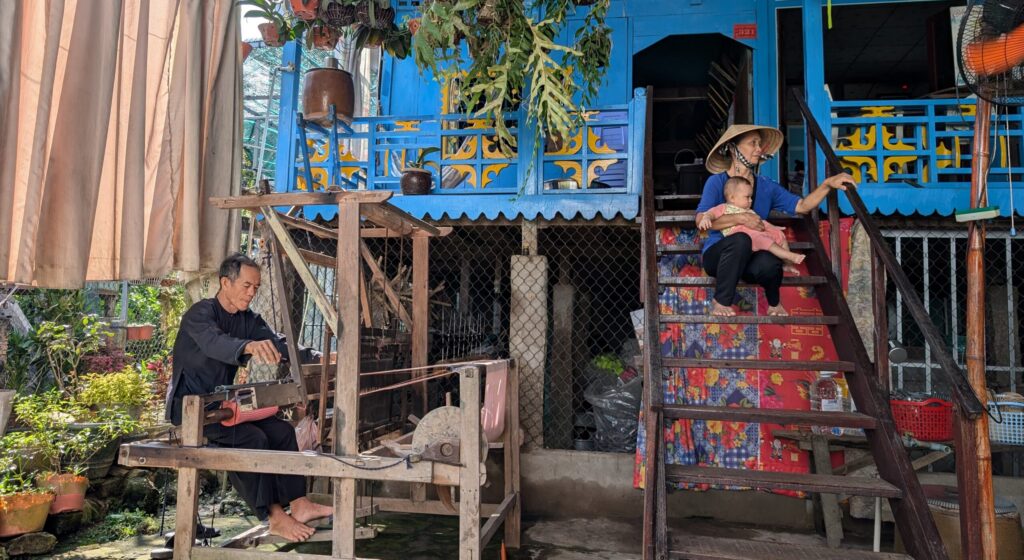
Homestays. Simple rooms, basic bathrooms, and a family who cooks an extensive dinner and eats it with you at a shared table, with conversation passed through a guide’s translation. Evenings often extend into card games, music, or just sitting together past dinner — the kind of evening a hotel doesn’t really offer.
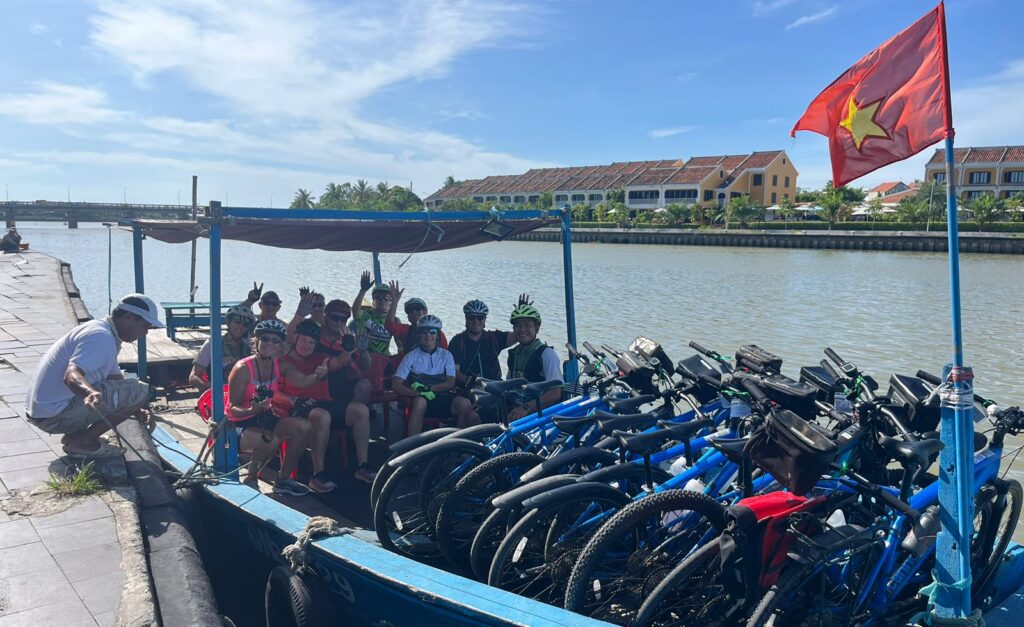
The riding itself. Narrow paths along canal banks, ferry crossings where bikes load alongside motorbikes and market-bound families, and villages that tourism hasn’t really reached, where curiosity and a wave are the typical response to a passing cyclist.
Cultural stops. Coconut candy workshops, rice paper production (watching the process and trying, unsuccessfully at first, to make one yourself), fruit orchard visits, and brick kilns that have supplied the region’s buildings for generations.
Who the Delta Suits
It works particularly well for beginners and non-cyclists — daily distances of 40-70 kilometers with negligible elevation gain, manageable for anyone willing to pedal for a few hours with the support vehicle always nearby. For culture-focused travelers, the slower pace and homestay structure create more room for genuine connection than the often performance-focused mindset of mountain routes allows. Families benefit from flat terrain that doesn’t exhaust kids or parents, plus hands-on activities that hold a child’s attention better than another mountain view would. Older cyclists can manage the Delta in ways they often can’t manage Ha Giang, given joint-friendly terrain and the absence of cardiac stress from sustained climbing.
It’s also worth considering for experienced cyclists looking for something different — not because the Delta replaces a serious physical challenge, but because it offers a different kind of trip, oriented toward experience rather than athletic effort, which some strong riders find genuinely refreshing precisely because it’s not what they usually do.
What the Delta Isn’t
It’s not an athletic challenge, and it won’t build climbing legs or give you a hard physical test — if that’s the point of your trip, look elsewhere. It’s also not dramatic scenery in the way mountains are; the beauty here is subtler and rewards slowing down rather than delivering an obvious “wow” moment. Homestays are authentic rather than comfortable in a Western sense — basic bathrooms, simple food, real heat and humidity. And the Delta rewards patience; if a meandering, unhurried pace frustrates you, this isn’t the route to fight that instinct on.
Practical Notes
Season: dry season only, November through April. The rainy season (May-October) brings real flooding that makes paths impassable, and December through February offers the most comfortable temperatures.
Duración: 3-5 days is typical, with 4 days as a reasonable sweet spot — enough time for multiple homestays and a floating market visit without the flat terrain starting to feel repetitive.
Combining with other routes: the Delta works well either before a mountain route (building saddle time and heat tolerance first) or after one (a gentler close to a harder trip), or as a standalone paired with a few days in Ho Chi Minh City.
Costo: among the most affordable regions in Vietnam to cycle. A 4-day tour, including bikes, guide, homestays, meals, and activities, typically runs $300-500; with flights and a few days in HCMC added, total cost for a week comes to roughly $1,200-1,800.
Conclusión
The Mekong Delta won’t give you summit photos or a serious physical test. What it offers instead — a homestay dinner, the floating market at dawn, the feeling of being welcomed into someone’s home for a night — is harder to put in a single photo but tends to stay with people longer. Mountains and the Delta are both real Vietnam, just different versions of it. If elevation profiles have been the thing holding you back, or you’re after connection more than physical accomplishment, the Delta is worth serious consideration.
